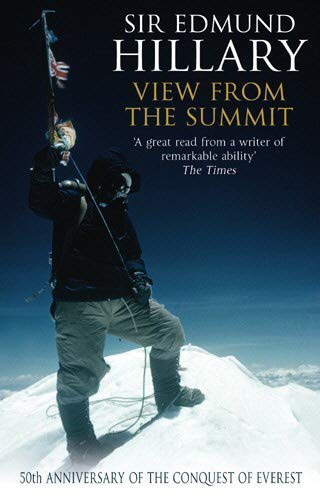
Unfortunately, I realized in the wi-fi-suffocated reaches of the Himalayas that I could not access the book I initially put down as my bookclub choice. On the bright side, the tea house I was staying at had another, tantalizing option – View from the Summit by Sir Edmund Hillary – the first person, along with Tenzing Norway, to summit Mount Everest.
As a result, I’ll spend a bit more time in this post talking about Hillary and Tenzing and their impact on the Himalayan region.

Hillary, originally from New Zealand, was born in 1919. In 1939, he made his first major climb, reaching the summit of Mount Ollivier in New Zealand. After serving in the Royal New Zealand Air Force in World War II, he was a part of the British reconnaissance expedition to Everest in 1951. In 1953, Hillary and Norgay, with the support of 362 porters and 20 sherpa guides, submitted Everest, spending about 15 minutes at the peak.

Starting around 1960, Hillary devoted himself to assisting the Sherpa people of Nepal through the Himalayan Trust. His and Norgay’s efforts are credited with the construction of several schools, hospitals, and airfields in Nepal.
Norgay was born in 1914 and raised in Tengboche, a small hamlet with a Buddhist Monastery that many trekkers pass on their way to Everest Base Camp. He had his first opportunity to join an Everest expedition at age 20, when Eric Shipton assembled the 1935 British Mount Everest reconnaissance expedition. Norgay participated as a high-altitude porter in several British attempts to climb everest throughout the 1930s. In 1947, Norgay participated in yet another unsuccessful summit attempt of Everest. Despite these failures, Norgay was able to develop a strong memory of the climbs necessary to complete the summit, proving to be invaluable in the 1953 attempt with Hillary.

After summiting Everest, Norgay became the first Director of Field Training of the Himalayan Mountaineering Institute.
Both Tenzing Norgay and Edmund Hillary played a vital role in transforming the Himalayan region into what it is today – and I highly recommend reading Hillary’s book, or Norgay’s autobiography, Tiger of the Snows, for anyone interested in how mountaineering played a role in shaping the Himalayas today.
Over the next few weeks, I will be reading The Sorrow of War by Bảo Ninh, which offers a Vietnamese soldier’s perspective of the American invasion of Vietnam from 1955-1970.
 Sam on Sabbatical
Sam,
How do you find the time and energy to read after strenuous, exhausting hiking?
I’d be falling asleep after 3 pages! You are amazing. Love your blog.
LikeLiked by 1 person