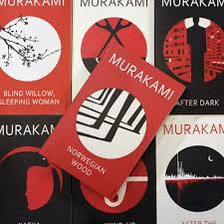
My final book, Norwegian Wood, is a 1987 novel by Japanese author Haruki Murakami. The novel is a nostalgic story of loss, PTSD, and searching for love, written from the first-person perspective of Toru Watanabe, who looks back on his days as a college student living in Tokyo.
The title of the book is based on the Beatle’s song, Norwegian Wood, which is often described in the novel, and is the favorite song of the character Naoko.
Interestingly, Mori in the Japanese title translates into English as “wood” in the sense of “forest” not the material “wood”, even though the song lyrics refer to the latter. This is important as forest settings and imagery are significant in the novel.
I am a pretty big fan of Murakami and his meditative train-of-thought writing style. While this book did not end up being one of my favorites of his, I liked how the intimacy of the story offered me an insight into Japanese individuality. A culture worlds apart from my own, it was helpful to have Murakami as a guide through my temporary assimilation and understanding.
Murakami was born on January 12 (my birthday!), 1949, in Kyoto during the post-World War II baby boom and grew up in Kobe. His father was involved in the Second Sino-Japanese War, and was deeply traumatized by it, which, in turn, had an affect Murakami. In 1970, Murakami moved to Tokyo to study drama and literature at Waseda University. He published his first novel, Hear the Wind Sing, in 1979, after working as the owner of a small jazz bar for several years. Murakami’s writing has often polarized readers, and he has often been criticized by Japan’s literary establishment as un-Japanese, leading to Murakami deeming himself the “black sheep in the Japanese literary world”.



Here are a few of my favorite other books by him:

Norwegian Wood is set in late-1960s Japan, and details the journey of its main character, Watanabe, through a variety of romantic relationships, particularly with two women, Naoko and Midori. Each of the three characters has experienced intense loss and grief, and each have their own methods of coping. Watanabe and Naoko share a childhood trauma when Kizuki, Watanabe’s best friend and Naoko’s long-term boyfriend/soulmate, commits suicide on his 17th birthday. Separately, Midori is forced to navigate an absent father in the backdrop of her mother’s death from brain cancer. Each character manages their youthful losses in different ways – detachment, estrangement, self-harm – while also navigating their burgeoning adulthood.
I found myself really connecting with this journey It made me feel more justified with my own meandering in the wake of my mother’s death. In a lot of ways, this 6-month trip has been the culmination of 8 years of trying to recenter myself – to define who I am in the deluge of my past and the identity I wish to cultivate in the future.
The most significant element of Japanese culture I took away from my time there was the high level of respect they offer people, places, and things. Everywhere in Japan people bow to show respect to all people. The lower they bow the more respect they have for the person – bowing upon greeting and upon leaving. Form a very young age, Japanese people are taught to value family members and strangers with huge respect. They are taught to behave respectively in the presence of adults. Japanese culture is a great model a hierarchic society based on mutual respect. It emphasizes the respect of privacy and allows those who are distinguished elders to influence the youth through teaching them how to respect each other.
As I wrap up this 6-month transition, and begin the next stage of my journey, I hope to bring with me that foundation of respect for myself that I cultivated over the past 8 years and firmly solidified jaunting around the world these last 20 weeks.
Thanks for following along,
Sam
 Sam on Sabbatical