
Hanoi – “Inside of the Rivers”
Hanoi is the capital and second-largest city in the Vietnam, located within the Red River Delta. The city’s history dates back to 200 BCE, when a portion of the area served as the capital of the Au Lac civilization before being taken over by China’s Han Dynasty. The city celebrated its 1000-year anniversary in 2010 when Vietnamese emperor Ly Thai To founded the capital of the imperial Dai Viet nation.
The city was first named Hanoi in 1831, and served as the capital of French colonial Indochina from 1902 to 1945. The Democratic Republic of Vietnam established Hanoi as its capital, which would last during the First Indochina War (1946–1954) and the Vietnam War (1955–1975). Hanoi has been the capital of the Socialist Republic of Vietnam since 1976.
Packed with history, the city boasts a powerful fusion of identities that offer a great diversity of architecture, culture, and, of course, food!
Catching a night bus from Hue, I arrived in Hanoi in the early morning. Eager to get started, I dropped my gear off at the hostel and headed into the city.
I first visited the Hoan Kiem Lake and the Ngoc Son Temple, which were just a few minutes from my hostel in the Old Quarter.


After I got my fill of the scenic lake-temple-bridge combo, I headed to the Temple of Literature. Built in 1070, the temple hosts Vietnam’s first national university, the Imperial Academy. It is one of a few temples in Vietnam dedicated to Confucius, sages and scholars. The temple is also featured on the back of the 100,000 Dong banknote!


Feeling a bit tired from the bus ride, I searched for a coffee shop and came across one of the best cafe’s I’ve ever been to. A “pay what you feel” coffee-bar, “Phin Bar”, offered me a proper introduction into the wonderful world of Vietnamese specialty coffee. A cafe with a couple locations, I would return here multiple times for my caffeine fix.


After re-caffeinating, I visited Ho Chi Minh’s Mausoleum. Reminiscent of the Tomb of the Unknown Soldier in Arlington Cemetery, the monument serves as the resting place of former-Vietnamese revolutionary leader and President. I spent some time here to learn more about Ho Chi Minh and his history. Born in 1890, he left French Indochina at 21 and spent the next 30 years living abroad in France, Britain, the U.S., the Soviet Union, and China. From 1919 to 1923, he began to show an interest in politics while living in France – and his political convictions continued to grow and develop over the course of the next 2 decades. In 1941, Ho Chi Minh returned to Vietnam to lead the Viet Minh independence movement against the Japanese occupation. Following a successful revolution in 1945, Ho Chi Minh became the Chairman of the Provisional Government of the Democratic Republic of Vietnam.
Fast forward to the conclusion of the 1954 Geneva Accords, Communist forces led by Ho Chi Minh regrouped in the North while the anti-Communist groups settled in the South. This is where Ho Chi Minh would serve until his death from heart failure in 1969, in the midst of the Vietnam War. I’ll have more to say about Ho Chi Minh when I discuss the Vietnam War but that’s enough for now.


Fun Fact: In 1946, future Israeli Prime Minister David Ben-Gurion and Ho Chi Minh met when they stayed at the same hotel in Paris. He offered Ben-Gurion a Jewish home-in-exile in Vietnam, but Ben-Gurion declined, telling him “I am certain we shall be able to establish a Jewish Government in Palestine”.
The next day I spent the day exploring the other main landmarks, hanging out at cafes, and eating a lot of food.


Ninh Binh

After a couple days in Hanoi, I caught an afternoon bus to Ninh Binh, a small town in the Red River Delta about 2 hours south of Hanoi.
When I was initially planning my Northern Vietnam trip, a lot of people said I should skip Ninh Binh – that it was nothing special/worth the drive south. After spending a couple days there, I would say it is VERY MUCH worth it for anyone in the area – even if just for a day or two. A mesmerizing area known locally as ‘Ha Long Bay on Land’ thanks to the sheer limestone mountains looming over rivers and paddy-fields. The best way to explore the UNESCO world heritage site is taking a paddleboat tour along its rivers, and motor biking around its ancient city ruins and temples.
The first day I rode around, taking in the scenery and exploring the temples and ruins.


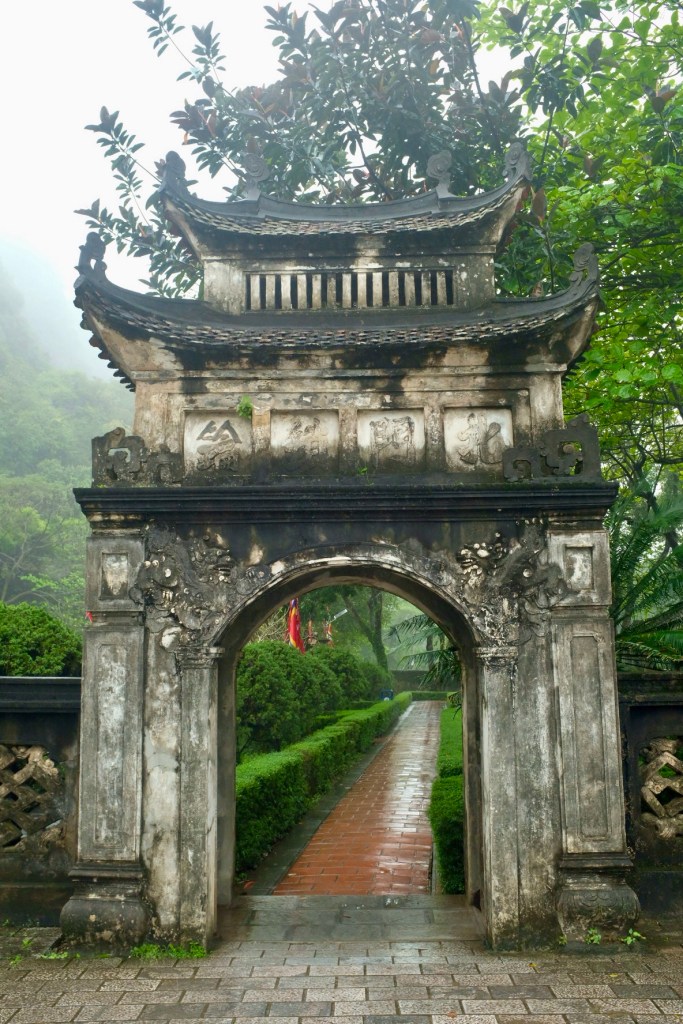


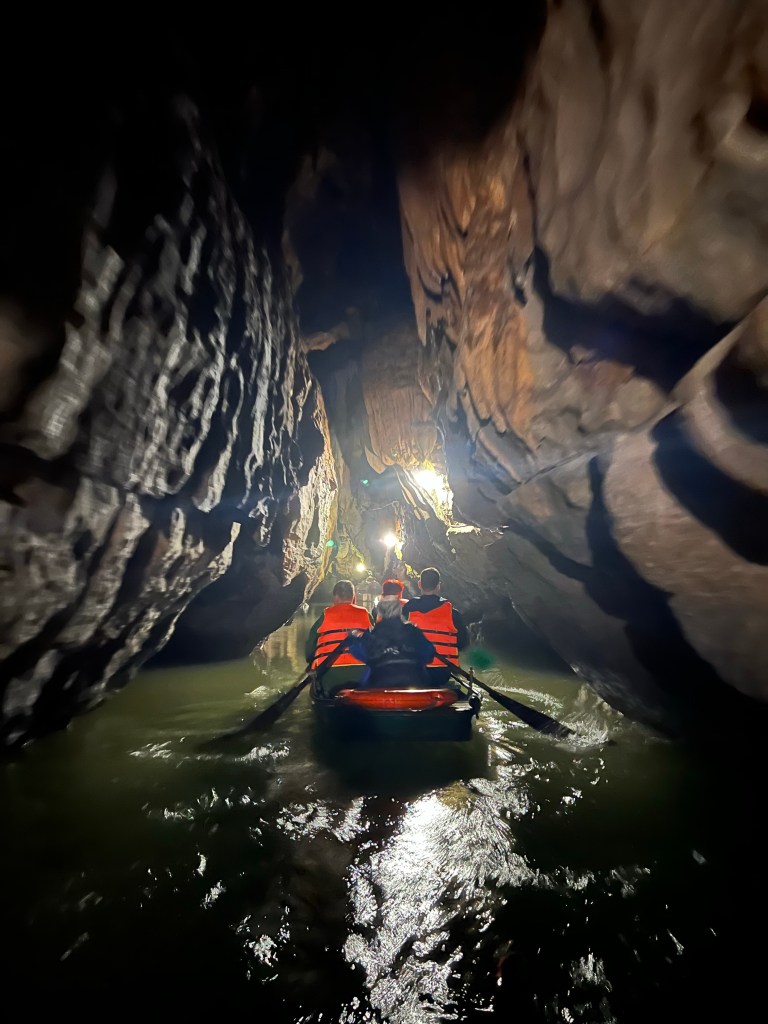
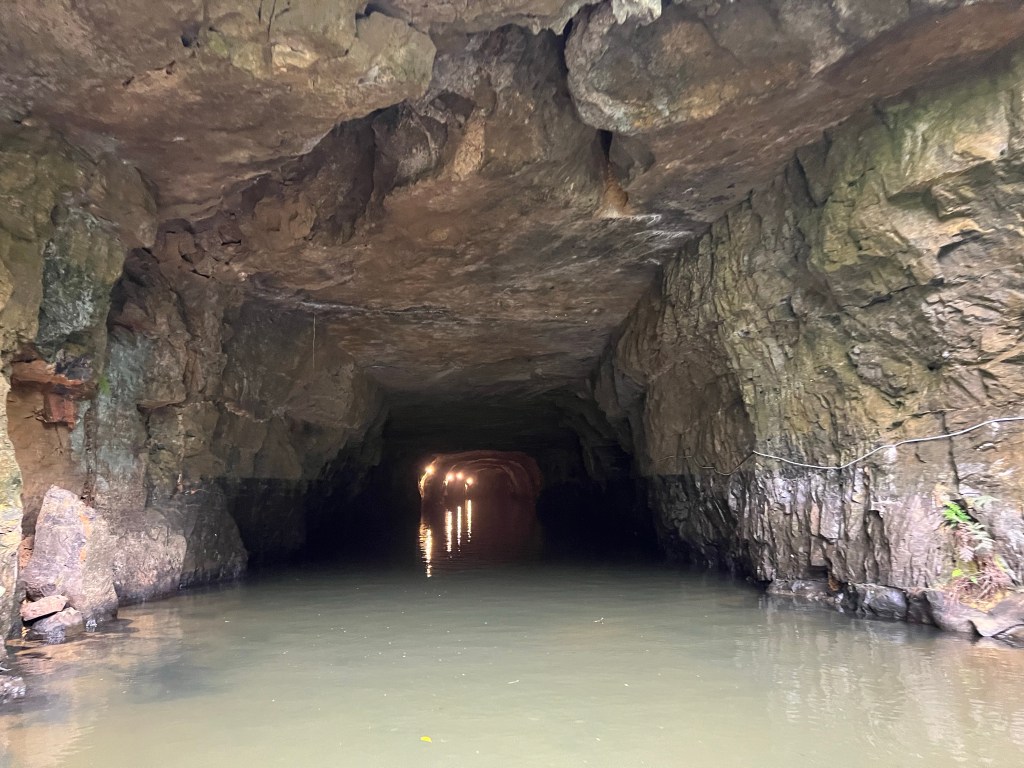
The next day, a friend and I took a boat tour around the rivers, temples, and caves in the area.





The second night, I drove around looking for a place to eat. Stumbling upon this small outdoor cafe, I ordered some soup, stir fry, and rice and sat around sipping ginger lemon tea. The food was, to my surprise, some of the best I’d had in Vietnam – so when I saw the restaurant-owner’s family sitting down to eat, I went over to compliment the mother who made my food. They quickly invited me to join them, having me try their meal – prawns, pork belly, bamboo shoots and rice – clementines for dessert, all washed down with rice wine and beer. I wasn’t really drinking since I left São Paul but this felt like a special occasion, and so we drank, ate, and talked. I was already very full, but I had such a great time trying their food and chatting with them. A farming family, they’d lived in Tam Coc (the town next to Ninh Binh) their entire lives. The son, 27, was my age and worked at the family restaurant running its day-to-day management. The mother was the chef, and the father farmed and shopped for the food. While I didn’t ask, I couldn’t help but look at the mother and father, who seemed to be in their 60’s, and think to myself, “where were you during the war?”. It’s a common thought that has come to mind while I have been traveling in Vietnam. Often, I find myself quite moved by how successful and positive this country feels despite everything – and how I feel no animosity towards me as an American. It’s very powerful to witness after all I learned about the violence we committed here.
Back to traveling. Ninh Binh is a wonderful area and a nice respite from the busy city-journeying that took up a majority of my time in Vietnam thus far.
Now, back to Hanoi for Ha Long Bay.
Ha Long Bay

After returning to Hanoi from Ninh Binh, I splurged on a day cruise of Ha Long Bay, translated to “Descending Dragon”. A UNESCO world heritage site, the 600 square mile bay includes nearly 2,000 islets, most of which are made of limestone. The rock in the bay has gone through 500 million years of formation in different conditions and environments.
Here is a cool legend I found about the bay:
According to local legend, when Vietnam had just started to develop into a country, they had to fight against invaders. To assist the Vietnamese in defending their country, the gods sent a family of dragons as protectors. This family of dragons began spitting out jewels and jade. These jewels turned into the islands and islets dotting the bay, linking together to form a great wall against the invaders. Under magics, numerous rock mountains abruptly appeared on the sea, ahead of invaders’ ships; the forward ships struck the rocks and each other. After winning the battle, the dragons were interested in peaceful sightseeing of the Earth, and then decided to live in this bay. The place where the mother dragon descended was named Hạ Long, the place where the dragon’s children attended upon their mother was called Bái Tử Long island (Bái: attend upon, Tử: children, Long: dragon), and the place where the dragon’s children wriggled their tails violently was called Bach Long Vi Island (Bạch: white-color of the foam made when Dragon’s children wriggled, Long: dragon, Vĩ: tail), present-day Tra Co peninsula, Mong Cai.


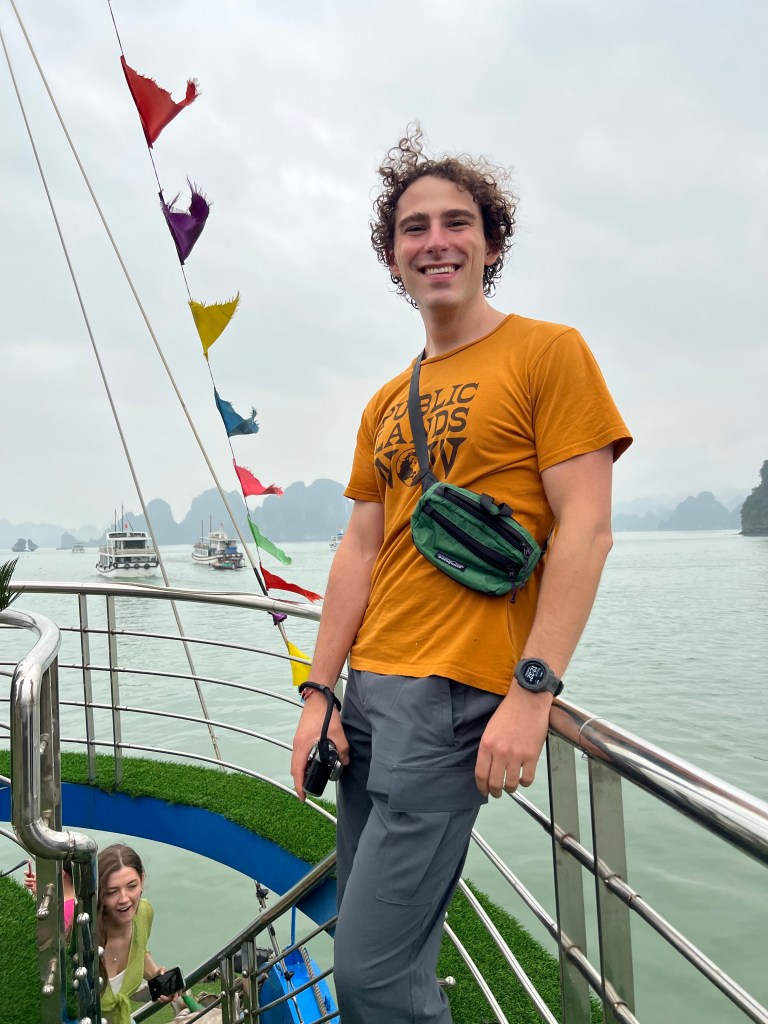

While on the bay, we also made a stop at the Hang Dau Go (Wooden Stakes cave), the largest grotto in the Ha Long area.


We were fortunate to have a great group on the boat, and we spent the day chatting about our travels, kayaking through the bay’s cave tunnels, and playing volleyball on Titat beach.
While quite touristy, the boat tour was a great chance to see the bay and its endless arena of monolithic limestone islands. It was well worth it.
Conclusion
Feeling much better, I’m looking forward to really taking advantage of all Northern Vietnam has to offer – and there is a lot.
See you next week, as I trek through Sapa and motorbike along the Ha Giang loop.
Sam
 Sam on Sabbatical